
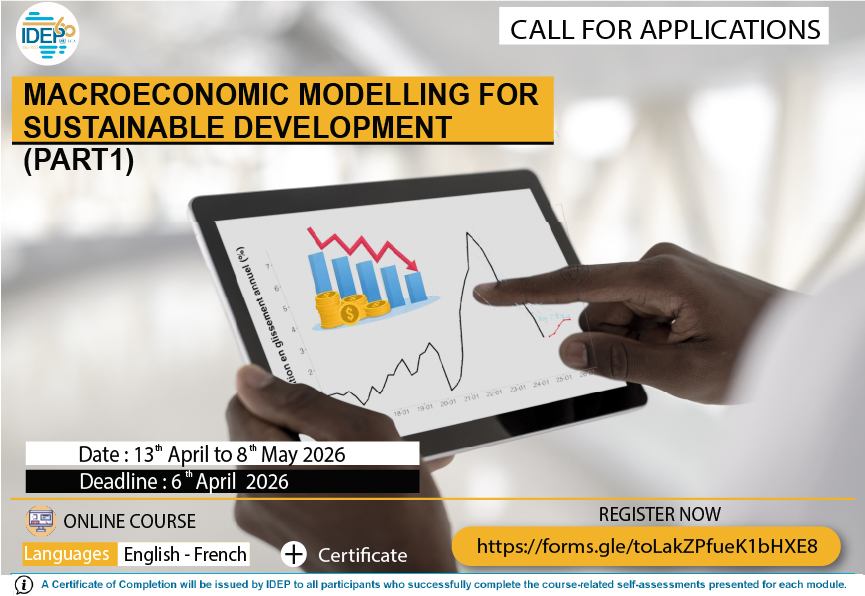
Macroeconomic Modelling for Sustainable Development (Part 1)
Announcement in Brief
|
Programme Rationale
Macroeconomic policy management is an important element in achieving the Sustainable Development Goals (SDGs). It is increasingly recognised as an important core strategy in the implementation of the 2030 Agenda for Sustainable Development and Agenda 2063.
Macroeconomic modelling in this respect is a key decision-making tool, as it aims torepresent the links between different macroeconomic variables in order to answer crucial questions about the impact of policy measures or economic shocks on growth, the functioning of economies, macroeconomic outcomes and the economic welfare inherent in these outcomes, and to make forecasts. Evidence-based policy formulation requires critical analysis of the macroeconomic environment. Models provide an important basis for grounding policy in reality. The results of economic model analysis and projections could inform policy formulation processes and help policy makers to propose relevant and coherent policy interventions in favour of sustainable development. In addition, macroeconomic modelling can be useful for simulating shocks to the achievement of the SDGs. Understanding the methods and tools of macroeconomic modelling is therefore essential for African decision-makers and economists for sustainable development.
Objectives
The aim of this training programme is to enhance the skills of young African economists
needed to develop, analyse and apply macroeconomic models to support economic growth and development on the continent.
This course, which is the first part of a comprehensive training programme, will be structured around the following modules :
- Module 1: Understanding economics: some basic concepts
- Module 2: The principles of economic modelling
- Module 3: Macroeconomic models: Their role in planning and implications for policy choices
- Module 3.1. Analysis of the closed economy: the Keynesian approach and the IS-LM model.
- Module 3.2. Open economy analysis: The IS-LM-BP model and the role of the external sector
- Module 3.3. Endogenous growth models (role of human capital and technology) according to Solow's approach
- Module 4 : Modelling and economic forecasting using regression models
- Module 4.1. Principles of multivariate regression analysis
- Module 4.2. Economic planning using time series analysis
- Module 4.3. VAR models and their implications for economic planning
- Module 5 : The practice of macroeconomic modelling - The IMF macroeconomic
model