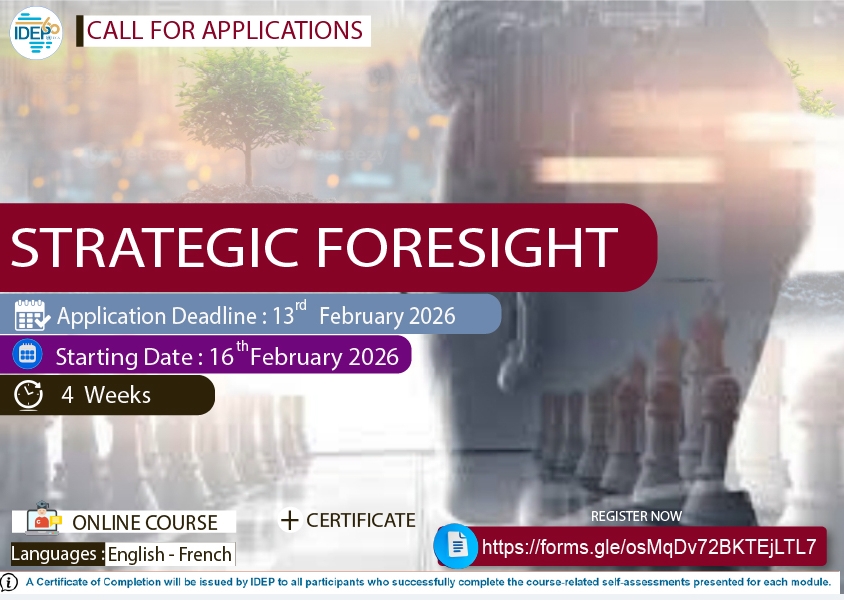
Strategic Foresight
Announcement in Brief
|
Programme Rationale
The 2030 Agenda for Sustainable Development, adopted by UN Member States in 2015, includes 17 Goals, 169 targets, and 231 indicators, and is anchored in human rights. The SDGs represent a shift from the earlier Millennium Development Goals (2000–2015) by being more universal, transformative, inclusive, and comprehensive.
However, the pace of progress is falling short. According to The Sustainable Development Goals Report 2025, fewer than one in five (about 16.7 %) of SDG targets are currently on track globally. In 2025, an estimated 808 million people, roughly 9.9 % of the world population, are living in extreme poverty under the updated threshold of USD 3.00/day (2021 PPP). As far as gender equality is concerned, there is still a lot of work to be done; by 2030 approximately 351 million women and girls will still be living in extreme poverty (UNSD, 2025). Despite gains in education completion rates, 272 million children and youth remain out of school, and learning outcomes are worsening in many places. Conflicts and wars inflict a devastating toll on SDGs as the number of forcibly displaced and stateless people could reach 139.3 million across 136 countries and territories by end-2025 (UNHCR projections).
Objectives
The course will capacitate learners on the implication of global megatrends for the future of the world and its implication for Africa. They will receive insights into the role of strategic foresight in conceptualizing long-term development strategies for the continent. They will also have a good understanding of key concepts and various analytical stages of the strategic foresight approach.
The course will cover the following modules:
- Module 1: Challenges and catalysts: Rethinking development planning in Africa
Module 2: History, development and practices of foresight
Module 3: The fundamentals of foresight
Module 4: Foresight approaches and tools
Module 5: From anticipation to action