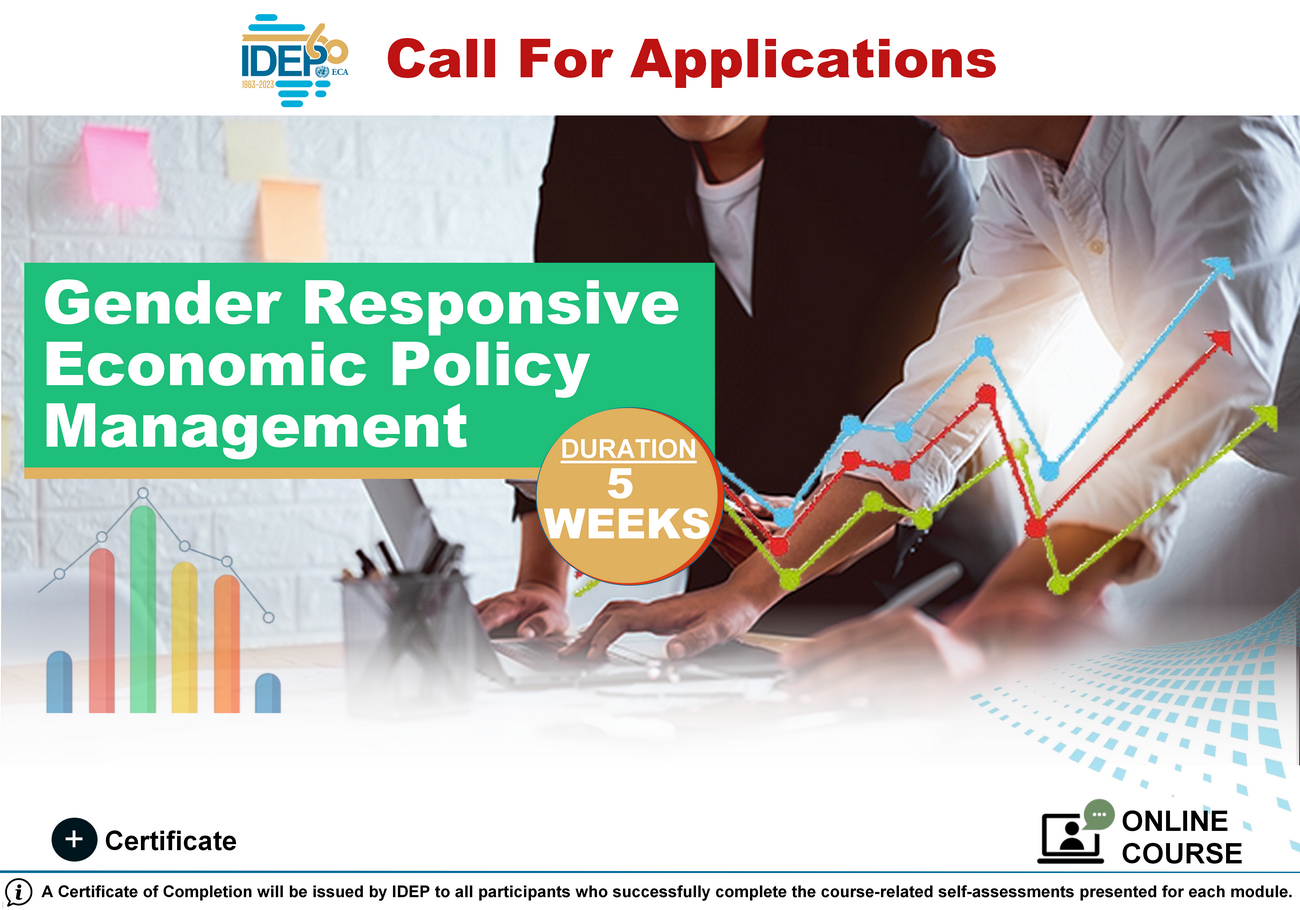
GENDER RESPONSIVE ECONOMIC POLICY MANAGEMENT
Description
Programme Rationale
Gender equality is a fundamental human right and a necessary foundation for a peaceful, prosperous and sustainable world. In the 2030 Agenda for Sustainable Development and AU Agenda 2063, gender equality is recognized as an essential catalyst for progress across all development outcomes.
Both frameworks that seek to achieve inclusive growth and sustainable development, present new opportunities for transformative change for women and youth in Africa.
Globally, there is increased demand for incorporating gender perspectives into the national development framework, upon realization that gender equality and equity are central to economic growth and poverty reduction in developed and developing countries.
Although, some countries have made enormous progress in achieving gender parity in some areas, overall, the gender gap in Africa, both in society and in the world of work, remains high.
This further reinforces and feeds inequalities and compromises the continent's long-term economic health. It is only when women are able to reach their full potential that Africa can fully harness its potential. Women make up over 50% of Africa's total population, but in 2018, they only generated 33% of the continent's collective GDP. Overall, progress towards gender equality has stalled. At the current rate of progress, it would take Africa 142 years to achieve gender parity1.
Evidence shows that investing in gender equality—such as increasing women’s access to health care, employment and credit—can accelerate economic growth and reduce poverty and that persistent gender inequalities reduce prospects for economic growth.
Yet, attention to gender equality still lacks in economic policy formulation, financing and implementation. This emerging evidence highlights the need for mainstreaming gender into economic policy formulation and implementation.
Objectives
The course on Gender-Responsive Economic Policy Management aims at providing policymakers and development practitioners with the required skills and knowledge that are needed to identify and address gender biases in the economic sectors and to analyze economic policies and budgets from a gender perspective.
The course also seeks to give tools mechanisms to assist Countries to deal with successive socio-economic shocks in this period of uncertainty and crisis.
This course is delivered by the African Institute for Economic Development and Planning (IDEP).
There will be two (2) online courses : One (1)for the francophones Members States and RECs; and Two (2) for the anglophones Member States and RECs.
The course is expected to enhance gender awareness in economic policy formulation, financing and implementation, as well as sharpen the understanding of participants on the links between gender and economic policy formulation and management.
From this course, it is expected that participants will become familiar with the analysis and use of gender concepts, tools and strategies; Expected skills upon completion include:
- Fostering an enhanced conceptual understanding of gender concepts in economic policy design, financing, implementation and evaluation.
- Enabling participants to acquire knowledge and expertise to formulate, implement, monitor, and evaluate policies, programmes and budgets from a gender perspective.
- Providing participants with knowledge and expertise to mainstream a gender perspective in national development policy dialogue and planning as well as in international negotiations.
- Providing participants with the tools and mechanisms to deal with successive socioeconomic shocks in this period of uncertainty and crises as women are particularly impacted.
- Developing gender mainstreaming action plans that will enhance gender equality and women empowerment in the formulation, implementation, monitoring, and evaluation of policies, strategies, programmes and projects.